
The Great Orme Brammock Rod Reconstruction Project
For many years, Tom Parry campaigned to have the remaining Brammock Rod pits on the Great Orme acknowledged for their importance to the Llandudno Victorian Copper mining Industry. In autumn 2012, a small amount of funding was made available from the Great Orme Country Park Community Engagement Scheme to the Great Orme Exploration Society in order to develop one of the former Brammock Rod pits and provide some information boards about the former structures. The reconstruction project got underway, and a small A-Frame structure was designed based on what is thought to be the original Brammock Rod system. The pits were excavated, stone work tidied up inside and text was supplied to develop information boards.
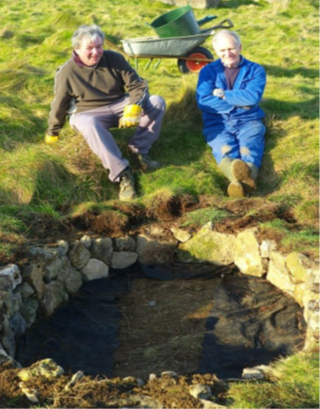
Steve and Brian taking a break from pit reconstruction work.
During 2013 Steve and team worked really hard on this project and the final phase of the main reconstruction work was completed at the end of April 2013 when three wooden A-frames with metal heads were fixed in place, then securely concreted into each pit.

Three Brammock Rod A-frames now in situ on the Great Orme, Llandudno.
BRAMMOCK RODS EXPLAINED
The Brammock Rod System is credited to Thomas Jones of Newmarket, Flintshire, the agent of the New Mine from 1827. It was powered originally by a Water Bucket Engine to provide power from one side of the Great Orme to the other by means of connected Flat-Rods. The animation below shows a diagrammatic view of how the system worked in simple terms, with the use of Angle Bobs to change direction.
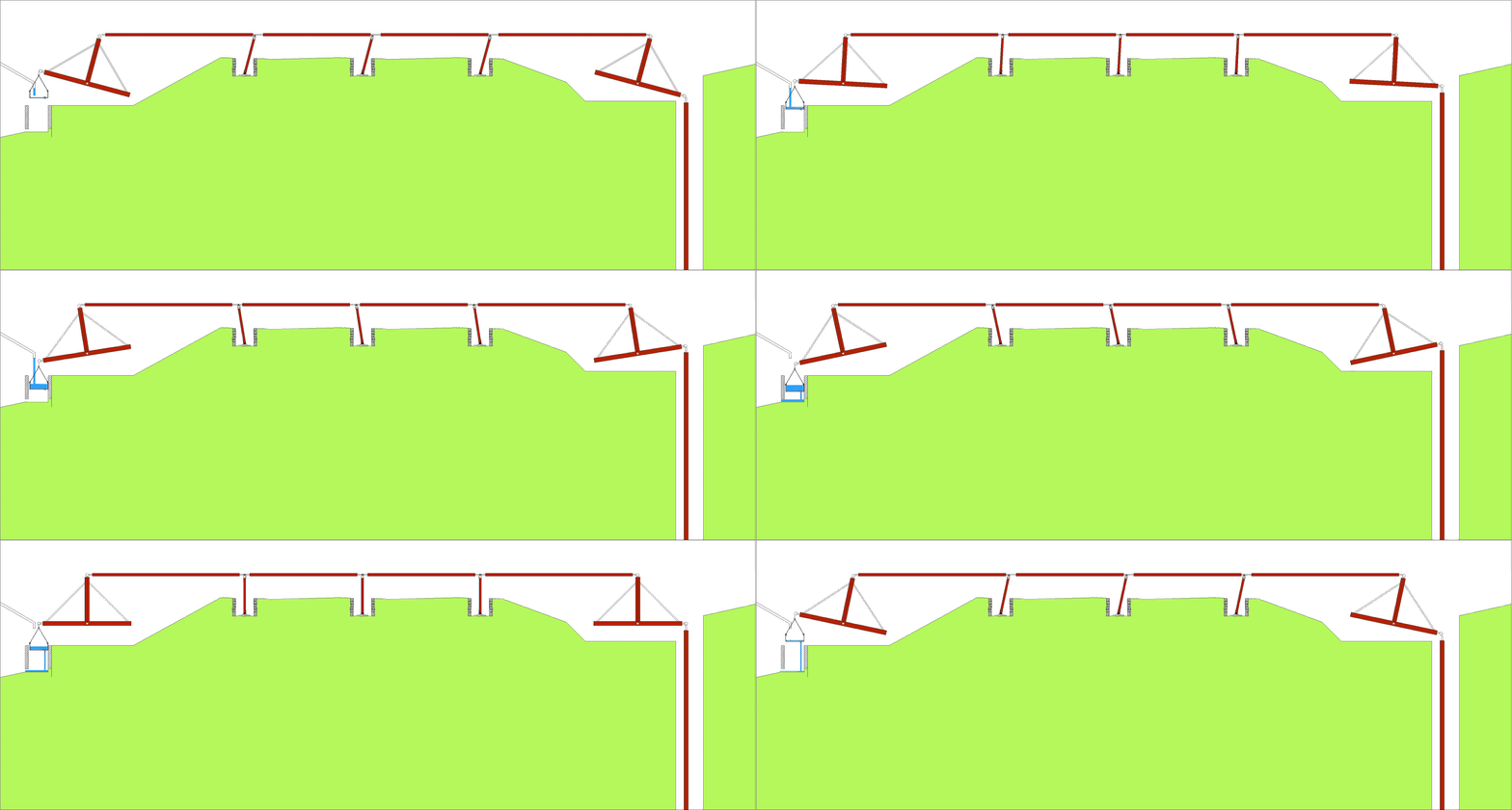
This was later replaced with a more efficient Water Pressure Engine which used a head of water as opposed to volume. This worked in a similar way to a single cylinder steam engine, but using water pressure, so was sited further down the hill. The following animation shows the engine in operation, but without the linkages to the Brammock Rods for clarity.

Both of these systems were made redundant on the 14th October 1842 when the Penmorfa Drainage Adit was completed. The adit took eight years to dig out, and once completed allowed free drainage of the mines at sea level.

Brammock Rod A Frames are still a great talking point and feature on our Summer Walks.
